10 Best Artificial Floral Arrangements for Home Decor
A room can feel finished with flowers, yet fresh bouquets need water, trimming, and regular replacement. Artificial Floral Arrangements For Home offer another option: lasting color without daily care. The best choice still depends on the room. A tall arrangement can anchor an entryway table, while a low, airy design suits a dining table without blocking conversation.
Floral designer Jeff Leatham is often associated with the line, “Flowers are always a good idea.” That sentiment fits faux arrangements, too, though scale and materials matter. Look for petals with subtle color shifts, stems that bend naturally, and foliage that does not shine like plastic under a lamp. Touch helps. So does viewing the arrangement in daylight.
This guide explores ten styles for different spaces, from sculptural branches to soft garden-inspired bouquets. It considers color, shape, vase choice, and placement, rather than treating every arrangement as a universal fit. A compact arrangement may disappear on a wide mantel. A dramatic one may overwhelm a small bedside table. Small details count.
And some faux flowers still look too perfect. That is worth noticing. Slightly varied stems and restrained colors often feel more convincing than a tightly packed, flawless cluster. Use these ideas as a starting point, then adjust for your room, light, and taste.
What Defines a Quality Artificial Floral Arrangement?
What Defines a Quality Artificial Floral Arrangement?
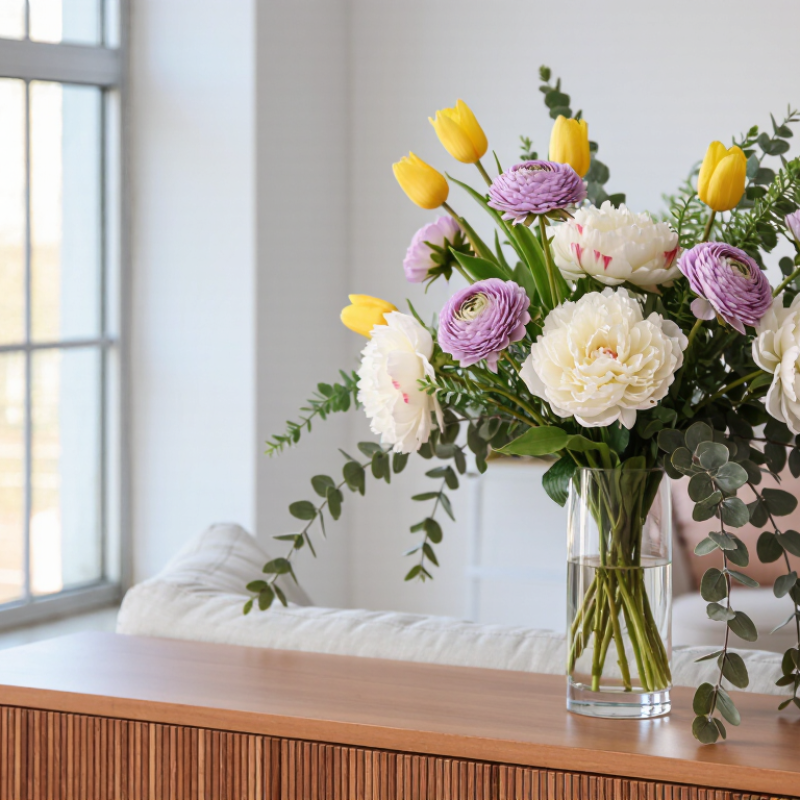
A quality artificial floral arrangement looks convincing from across the room and holds up under closer inspection. Examine the petals: their edges should feel softly varied, not sharply cut or uniformly glossy. Small details matter. Subtle color shifts near the center of a bloom can make it appear more natural than a single flat shade. Leaves should also have believable veins and varied angles, rather than forming a perfect, repeated pattern.
Materials affect both appearance and everyday care. Fabric petals often have a softer look, while molded materials can offer crisp shapes and resist dusting wear. Neither is automatically better; check that the finish suits the room and lighting. Stems should support the flowers without awkward bends, and the arrangement should sit securely in its vase. A piece that leans or sheds small parts may become frustrating, even if it photographs well.
Scale and composition matter as much as individual blooms. Look for different flower heights, some open blossoms, and a few less prominent shapes that create depth. Yet natural flowers are rarely perfectly balanced, and an artificial display can seem overly neat. That is worth considering. A little asymmetry, visible stem variation, or one muted bloom can make the whole arrangement feel more at home on a shelf or dining table.
Key Styles and Materials Used in Home Decor
Artificial floral arrangements work best when their style suits the room’s scale and light. For a calm bedroom, choose a few realistic stems in a narrow glass vase. A kitchen can handle looser meadow mixes, while sculptural branches add height to an entryway.
“Silk flowers” often use polyester, not natural silk. Polyester petals can hold fine color gradients, but stiff edges may look flat in direct sunlight. Polyethylene heads usually feel softer and more flexible. Wire-reinforced stems let you bend branches around a shelf or lamp. Small flaw: dusty creases can reveal the imitation.
Grand View Research estimated the global artificial flowers market at about US$1.9 billion in 2023, with a projected 5.5% annual growth rate through 2030. That signals broad demand, not proof that every arrangement is well made.
Check petal edges, stem joints, and how securely leaves attach. A mixed-material bouquet can look convincing from across a room, yet mismatched finishes may show up close. Not always. Recycled-content claims also deserve scrutiny; ask what parts contain recycled material, since stems, leaves, and petals may use different plastics. A little asymmetry helps, though overly uniform blooms can still feel staged.
Ten Artificial Floral Arrangements for Different Interior Styles
Artificial flowers work best when their shape and color suit the room, rather than competing with it.
For a contemporary interior, try sculptural orchids in a matte ceramic vase. Scandinavian rooms pair well with soft white hydrangeas and pale greenery. A farmhouse table can take loose wildflowers in a terracotta jug. Minimalist spaces often benefit from a few calla lilies. Traditional rooms feel at home with muted roses in a glass bowl.
For a bohemian corner, choose airy grasses with varied stem heights. Magnolia leaves and creamy blooms bring a coastal room a gentle, natural touch. A Japandi setting suits simple branches with restrained, earthy color. Sunflowers can warm a rustic kitchen, while deep dahlias add contrast to an eclectic living room. Check the leaves and stem joins up close; shiny plastic can look convincing from across the room, but less so beside a window. I learned that the hard way.
Tips:
Turn the arrangement toward the room’s main light source, then adjust individual stems so they do not form a stiff dome. Keep the vase in proportion to nearby furniture. A quick dusting every few weeks helps preserve the colors. Not every arrangement needs to look perfectly balanced.
How to Choose an Arrangement for Each Room
Choose an artificial floral arrangement by matching its scale, color, and shape to the room. In a living room, a fuller arrangement can soften a bare console or coffee table. Keep enough space for books, remotes, and cups. On a dining table, choose a low centerpiece so guests can see each other. A compact cluster of cream blooms and green leaves often feels calmer than a tall, crowded display.
Bedrooms benefit from smaller arrangements with muted colors, such as dusty pink or soft white. Place one on a dresser, away from the edge. In a bathroom, use a few moisture-resistant materials and avoid arrangements that block shelves or mirrors. For an entryway, a taller vase can add presence beside a narrow table, but check that it does not obstruct the walkway. Kitchens are busy spaces. A small arrangement near a window can add color without taking up valuable worktop space. I would avoid placing faux flowers beside a hob, where grease and heat can make upkeep harder.
Tips: Check the arrangement from the doorway and from your usual seat. Dust it regularly with a soft cloth or brush. If it looks too perfect, adjust a few stems; a little unevenness can feel more natural. Keep it simple.
Placement, Styling, and Care for Lasting Appeal
Artificial floral arrangements look most convincing when their scale suits the room. A low bowl of blossoms works on a dining table because guests can see across it. Taller stems belong on a console or beside a fireplace, where they have breathing room. Keep them away from busy shelves. Too many nearby objects can make even good flowers look crowded.
Style the stems loosely rather than arranging every bloom at the same height. Let one branch lean slightly, and turn a few flowers toward the light. A mix of leaf shapes adds depth, while a restrained palette helps the display fit existing cushions or artwork. Keep it simple. I sometimes find that perfectly even spacing looks stiff; a small gap or crooked stem can feel more natural. Still, check the arrangement from the doorway, where its overall shape is easier to judge.
Dust matters. Use a soft, clean brush or a cool hair-dryer setting to remove dust gently, especially around fabric petals. For stubborn marks, follow the care guidance for the material and test a hidden area first. Avoid leaving arrangements in strong, direct sunlight, which may fade colors over time. A damp cloth can help with some smooth plastic leaves, but it may damage delicate finishes. Rotate the arrangement now and then so one side does not collect all the light and dust. Proper care is not complicated, though I occasionally forget the hidden leaves.