Choosing the right supplier in China can help wholesale buyers offer greenery that looks convincing across homes, hotels, offices, and retail displays. Realistic Fake Plants vary widely in leaf texture, color, stem strength, and finish. A glossy leaf may look attractive online but appear artificial under bright showroom lighting. Small details matter.
Experienced buyers compare materials, construction, and consistency rather than relying on product photos alone. Check whether leaves have natural color variation, whether stems hold their shape, and whether pots suit your intended display. Ask suppliers about available sizes, customization options, minimum order quantities, and sample costs. Samples help. They reveal details that a screen can hide, including uneven edges or stiff branches.
This guide explores China’s best options for realistic artificial plants and explains what wholesale buyers should evaluate before placing larger orders. It covers popular product styles, supplier communication, quality checks, packaging, and practical sourcing considerations. Request clear specifications and confirm that samples match the production order. Also review carton dimensions and protective packing; damaged leaves can reduce a product’s appeal. Not every supplier will meet every requirement. That is worth remembering. A lower quote may come with trade-offs in finish, consistency, or service, so compare the full offer instead of price alone. Use these checks to make a more informed choice and select products that fit your customers, budget, and display needs.
A realistic artificial plant rarely depends on one perfect leaf. It looks convincing when many small details work together. Look for varied leaf sizes, natural spacing, and subtle shifts in green. Real foliage is not uniformly bright. Fine veins and gently uneven edges help, too. Check the underside. If every leaf has the same glossy finish, the plant may look plastic under shop lighting.
Stems matter as much as leaves. A believable branch should taper slightly and connect naturally, without obvious gaps or bulky joins. Bendable wire can help buyers shape a display, but it should stay hidden beneath the surface. Touch the foliage when reviewing a sample. Some soft matte finishes feel more natural than slick coatings, though texture alone cannot prove quality. I still find that photographs can flatter even an average product.
For wholesale orders, inspect samples in daylight and under warm indoor lights. Color can change more than expected. Compare several pieces from the same carton for consistent leaf placement, color, and finish. A little variation looks natural; large differences can make a bulk display feel mismatched. Ask how the plant holds its shape after transport, and examine the pot, seams, and exposed stems closely. Not every flaw is easy to spot. A bent branch or visible glue mark may only appear when the plant is arranged at eye level.

For wholesale buyers, realism begins with how a leaf catches light. A good leaf has varied green tones, visible veins, and edges that are not perfectly uniform. Thin translucent sections can mimic sunlight passing through fresh foliage. On a sample, gently bend a leaf and inspect whether its surface feels flexible rather than brittle. Small details matter.
Materials shape both appearance and handling. PE leaves can hold molded texture, while fabric foliage allows fine printing and soft movement. Wire-reinforced stems help branches keep their shape in a display. But material labels alone prove little; compare the finished leaves under daylight and warm indoor lighting. A glossy finish may look convincing in a photograph, then appear plastic under store lights.
Grand View Research’s 2023 artificial plants report valued the 2022 global market at about US$1.14 billion and forecast 4.8% annual growth through 2030. That growth makes quality checks more important for wholesale orders. Examine several pieces from a batch, not only the showroom sample. A painted vein can look too regular, and leaf spacing may vary more than expected. There is a trade-off. Buyers should also ask how foliage responds to dusting and repeated handling, since realistic color means little if leaves lose their shape quickly.
Wholesale buyers need artificial plants that suit different rooms, price points, and care expectations. Realistic ficus and olive trees work well in hotel lobbies, showrooms, and larger retail spaces. Their height creates impact, while varied leaf tones help avoid a stiff, repeated look. Check trunk texture and canopy shape in person. Photos can hide both.
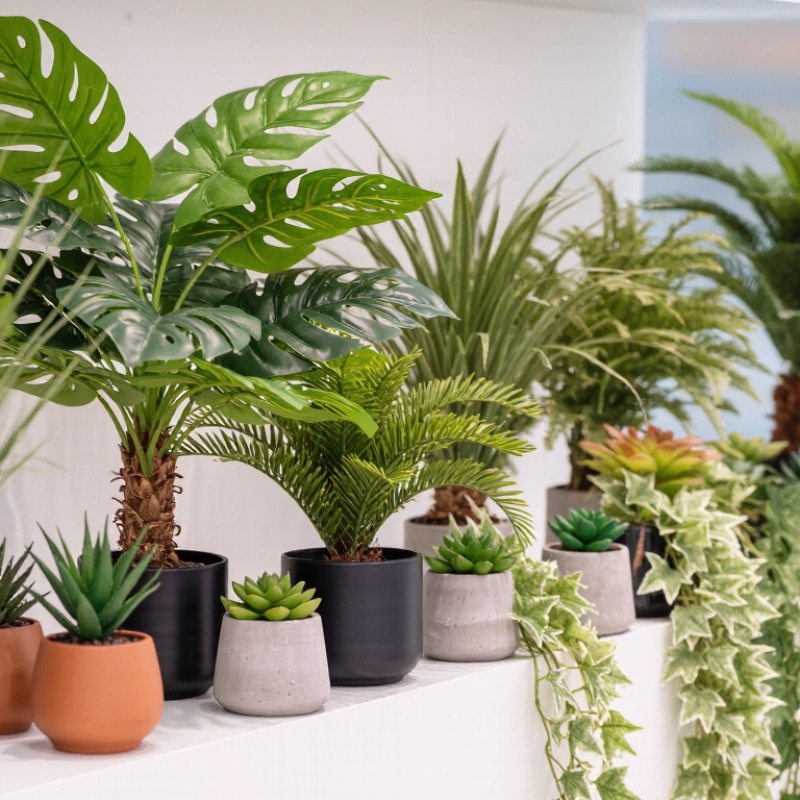
For compact displays, pothos and philodendron-style trailing plants fit shelves and hanging baskets. Monstera and palm varieties add broad, tropical foliage to offices and hospitality interiors. Succulents and small potted plants serve desks, gift shops, and seasonal assortments. Outdoor-focused buyers may prefer UV-resistant foliage, but color can still fade with prolonged sun exposure. Test samples first.
Wholesale assortments work best when sizes and pot finishes are easy to combine. Ask suppliers for plant dimensions, packed-carton measurements, and close-up images of leaf edges and stems. These details help estimate shelf space and reduce surprises on arrival. A realistic plant should have natural variation, not identical leaves across every branch. Some buyers overlook pot quality; it can make a convincing plant look cheap. There is no perfect mix. Review samples under the lighting where customers will see them.
Which artificial plant types meet wholesale market needs?
The 0–100 scores are an illustrative planning index, not measured market or sales data. They summarize common wholesale considerations: visual impact, ease of shipping and storage, durability, and suitability across retail settings. Use supplier specifications and buyer research to validate product decisions.
China Best Realistic Fake Plants for Wholesale Buyers
How to Evaluate Quality, Safety, and Customization Options
Grand View Research estimated the global artificial plants market at USD 1.68 billion in 2023. That growth makes supplier checks more important, not less. Request a production sample, then inspect leaf edges, color variation, stem joints, and the planter’s weight. Look for visible glue, sharp wire ends, or leaves that detach with a gentle tug. Inspect closely. A sample can still mislead if bulk production uses different materials, so ask how batches are checked.
Safety needs evidence. PlasticsEurope’s 2024 report put global plastics production at 413.8 million tonnes in 2023, underscoring why material traceability matters. Ask for material declarations and relevant chemical or flame-performance test reports for the intended sales market. Do not treat a generic certificate as proof for every product. Confirm the report matches the actual leaf, stem, and coating materials. Ask for proof.
Customization should be practical. Confirm leaf density, branch length, pot dimensions, color tolerance, carton protection, and sample approval before production. Request clear photos under neutral lighting; glossy leaves can look convincing online but harsh under shop lights. Agree on acceptable variation in writing. A small color mismatch may be tolerable, but repeated mismatches across a shipment can weaken a display. Suppliers should also explain lead times and how design changes affect cost. That conversation is easy to skip. It shouldn’t be.
| Evaluation area | What to check | Practical buyer benchmark | Verification method | Why it matters |
|---|---|---|---|---|
| Appearance and realism | Leaf shape, color variation, surface texture, stem detail, and visible seams. | Compare the production sample with approved reference photos under neutral lighting; check from both close range and normal display distance. | Review a pre-production sample and inspect several units from the finished order. | Consistent detailing helps the plants look natural across a retail display or project. |
| Construction and durability | Leaf and flower attachment, stem flexibility, pot stability, and loose components after handling. | Agree on an inspection plan before production; during sample handling, look for detached leaves, cracked stems, or unstable pots and document any defects. | Handle samples as they would be unpacked, arranged, and displayed; record defects by type and quantity. | Identifies products likely to be damaged during packing, shipping, or store setup. |
| Materials and documentation | Declared materials for foliage, stems, coatings, pots, and packaging. | Request a written material specification and safety documentation that matches the product and its intended destination market. | Check document dates, product or material scope, and consistency with the order specification; request third-party testing where required. | Clear material records support import reviews and help buyers assess applicable chemical requirements. |
| Market-specific safety | Chemical restrictions, labeling, and any fire-safety rules relevant to the product and its intended use. | Confirm destination-country requirements before ordering. For example, REACH restrictions may apply in the EU; toy requirements apply only when the product is marketed as a toy. | Have the importer or compliance specialist review applicable rules and request relevant test reports or declarations. | Requirements differ by market, product category, and intended use; one certificate does not establish universal compliance. |
| Color and finish consistency | Color match between approved sample and bulk goods; finish transfer or visible fading during normal handling. | Approve a physical color reference and define acceptable variation in writing; use an agreed test method if rub or light resistance is important. | Compare production units with the signed reference under consistent lighting; request test results for any specified performance claim. | A shared reference reduces disputes about color differences between samples and shipment lots. |
| Customization options | Plant species and dimensions, leaf color, stem count, pot style, arrangement, and packaging artwork. | Specify measurable details such as overall height, pot dimensions, color references, and packing configuration; approve a prototype before bulk production. | Confirm the specification, sample approval, tooling or artwork charges, minimum order quantity, and any change-control process in writing. | Detailed specifications make custom orders easier to reproduce and inspect. |
| Packaging and shipping readiness | Protection against crushing, moisture exposure, abrasion, and deformation during transport. | Confirm carton dimensions, packing quantity, and any protective inserts; test whether plants can be reshaped after unpacking as intended. | Review a packed sample and agree on carton markings and shipping-pack requirements before dispatch. | Packaging affects freight efficiency and the condition of goods on arrival. |
Note: The benchmarks above are practical procurement checks, not universal legal limits or certifications. Confirm specifications and applicable requirements for each product, destination market, and intended use.
When comparing Chinese suppliers of realistic artificial plants, request the same product details from each: overall height, pot dimensions, foliage material, stem construction, and carton quantity. Photos help, but they cannot show how leaves feel or whether branches hold their shape. Order samples where possible, then inspect leaf edges, color variation, base stability, and packaging after delivery. Small differences matter.
Compare complete quotes, not just unit prices. Ask whether the price includes inner boxes, export cartons, custom labels, and sample fees. Confirm the minimum order quantity and whether mixed styles count toward it. Freight, duties, and handling can change the final cost, so clarify the shipping term and destination assumptions in writing. Keep each supplier’s offer in one spreadsheet. Details matter.
Order terms deserve the same scrutiny as product quality. Confirm production lead time, payment milestones, artwork approval dates, and how defects or shortages will be documented. Agree on an inspection method before production, such as checking carton counts and a sample of finished pieces against the approved sample. Even a careful checklist misses something; leaf color may vary slightly between batches. Ask how the supplier manages that variation, and keep approved photos and specifications with the purchase order.